Logo

Evanston Symphony Orchestra

Lawrence Eckerling, Music Director

Announcing Our 2026–2027 Season

For The Love of Music

Subscribe Today

Save up to $50 and get the best seats

Celebrating Beethoven’s Brilliance
Great Romantics
Saint-Saëns Organ Symphony
A Mass for Peace

Musical Insights

Free Pre-Concert Preview Series!

Musical Insights Icon

Enhance your concert experience with a sneak preview — Composers come alive and their passions take center stage when ESO Maestro Lawrence Eckerling takes you on an insider’s tour of the history and highlights behind the music.

Merion’s Crystal Ballroom

529 Davis St, Evanston.
FREE and open to the public.

Please RSVP to 847-570-7815.

Light refreshments will be served and casual tours of apartments will be available after the program.
Latest News

Evanston Symphony Orchestra offering special holiday show for people with special needs, by Chris Gillock

Dec. 14 performance will welcome those who vocalize, move and have different ways of experiencing music

So Long, John Russell—and Thanks!

Retired ESO timpanist John F. Russell was born in ­Gloucester, England. His parents worked in a nursing home there ­until an American relative in Cicero offered his father work and housing.

June 2025 concert videos

Please enjoy these wonderful videos from our June concert

Ko-Eun Yi playing Ravel's Piano Concerto in G Major.

A Passionate Pastoral Symphony

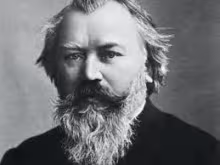
Johannes Brahms (1833-1897) was a German composer of the mid-romantic era. He was born in Hamburg but spent much of his life in Vienna. At a young age, he learned to play the violin and the basics of the cello. At age 7, he studied piano with Otto Friedrich Willibald Cossel.

An Exuberant Masterwork

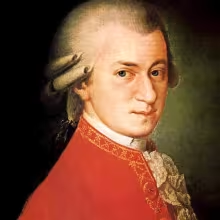
Symphony No. 41 in C Major was Wolfgang Amadeus Mozart’s (1756-1791) longest symphony and the last one he composed.

Let Your Spirit Soar

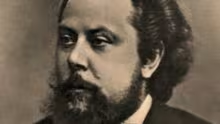
When you hear the Evanston Symphony play Pictures at an Exhibition, you will experience the beauty and originality of the paintings of Russian artist Viktor Hartmann (1834–1873) as interpreted by his good friend and composer Modest Mussorgsky (1839–1881).